Every subject they sit,
and it marks the work.
All 23 subjects, against the AQA, Edexcel and OCR specifications. Your child types an answer to a past-paper-style question and gets it back marked against the criteria an examiner uses — with the reason the mark was won or lost, not a tick. At ten at night, when there is nobody in the house to ask.
Three questions without an account. 48 hours of everything with one, and still no card. Then £7 a week, cancel whenever.
Before you decide
Seven minutes, every subject.
A real question opened, answered and marked in each one — chaptered, so you can jump straight to the subject your child is worried about.

Who they are talking to
This is Mio.
She is the same tutor in every subject — Chemistry at nine, French vocabulary at half ten, a past paper on a Sunday. One name, one face, whichever door your child comes in through.
She is an AI tutor, and she says so. Ask her what she is and she tells you plainly, in those words. She is drawn rather than photographed for the same reason: nobody should have to wonder whether there is a stranger at the other end.
What she does is the part that moves marks. She reads what your child actually wrote — not the word count, the answer — and tells them what an examiner would have given it, and why. Children get better at exams by finding out what went wrong while they still remember writing it, and she is there at the hour that happens.
What it actually looks like
Not a worksheet. A place that shows the thing.
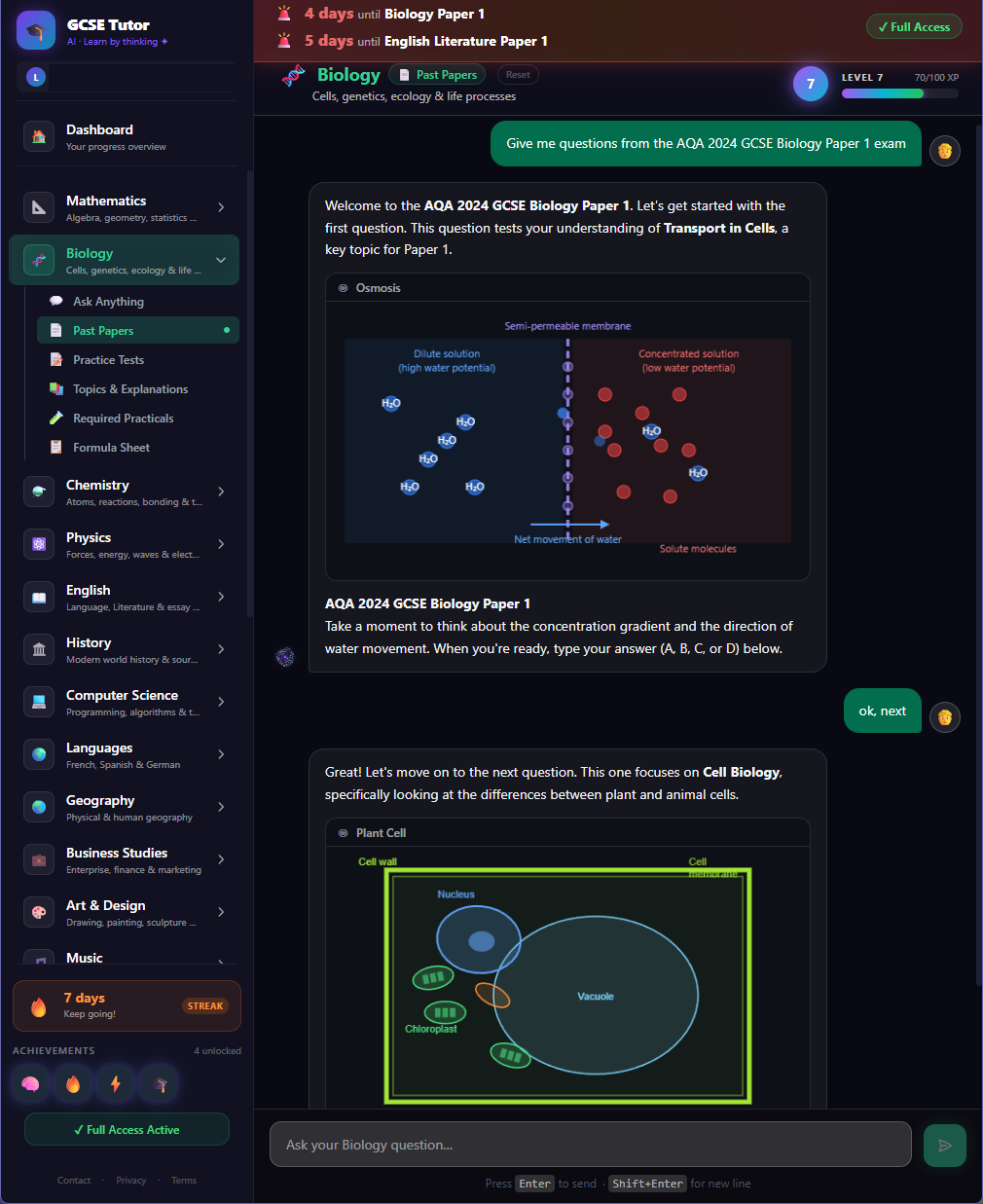
Past papers, marked and explained
Questions are adapted faithfully from real board papers, with the mark scheme criteria behind them. A student types a full written answer and is told which marks they earned and which they missed — in the language the examiner uses.
Tools that show it, not just describe it
Maths has an interactive graph and shape canvas. Students plot functions, drag shapes and read live measurements — the concept moves instead of sitting still on a page.
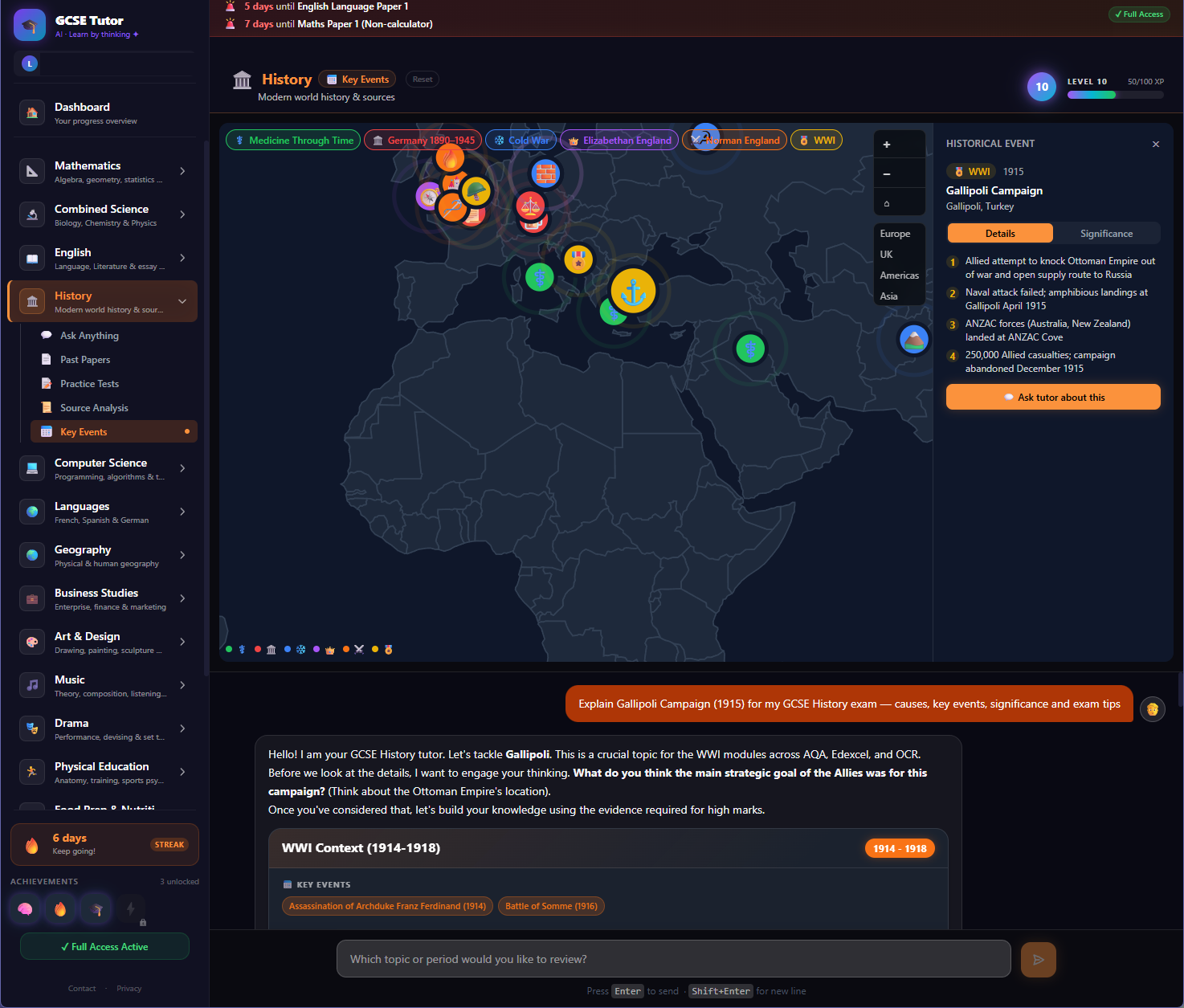
Maps you click through, for History & Geography
Key events are pinned on an interactive map. Each one opens into causes, events and significance — the structure the humanities papers actually reward.
From maths to media studies
One subscription, twenty-three subjects.
23 subjects, including the ones that are hard to find a tutor for
Maths, the three sciences, English language & literature, the humanities, French / Spanish / German, the arts, and the smaller options — Psychology, Sociology, Economics, RS, Business, Statistics and more.
Board-aligned content
Written against the specifications, with the AQA / Edexcel / OCR differences flagged where they matter.
Works on anything
A browser on a Chromebook, an iPad or a phone. Nothing to install, nothing for IT to approve.
Marked against the criteria
Full written answers get feedback in the examiner's own language — where the marks are, and where they went.
Built for the ones who will put the hours in — and it rewards them for it.
Unlimited practice with real feedback, at any hour, across every subject they sit. We won't promise grades — nobody honestly can — but a child who wants to work gets somewhere to do it properly on a Sunday night, without waiting for Monday.
Trying it
Three steps, no sales call.
Open it tonight
Go to the app and ask it something. No account, no card, nothing to fill in. Make an account and you get 48 hours of everything — still no card, and nothing to cancel if you walk away.
Test it on something you can check
Pick a subject you know, or a past paper you have at home, and read what it says about the answer. The marking is the part worth judging — anyone can show a child a video.
Only then, pay for it
£7 a week or £25 a month, cancelled whenever you like, from the account page. If it is not earning its keep in a fortnight, stop it — we would rather that than a subscription nobody opens.
Cost
Priced plainly, in writing.
Everything, for a week at a time. The one to take in the fortnight before a paper, or to try properly without committing to a month.
All 23 subjects, every mode, as much as they will use it — about five pounds less a month than paying weekly, and less than one hour with a private tutor. Cancel from the account page whenever you like.
Where this sits
| A revision platform | A human tutor | GCSE Tutor | |
|---|---|---|---|
| How it is charged | Usually per pupil, per year | Per hour, per pupil | £7 a week or £25 a month one child, every subject, cancel whenever |
| Notes, videos and quizzes | Yes | No | Yes |
| Diagrams, interactive maps and 3D models in the lessons | Some | No | Yes |
| Real past-paper questions, all three boards | Varies | Whatever the tutor brings | Yes |
| Marks a written answer against the real mark scheme | No | Yes | Yes |
| Tells a pupil which mark they missed, and why | No | Yes | Yes |
| There at ten at night, and in half term | Yes | No | Yes |
| Subjects covered | Varies — often one subject area | One, usually | All 23 |
| Stores what a pupil types | Usually | — | Never |
The row in bold is the one that decides it. A revision platform hands a pupil content; a tutor reads what they wrote and tells them where the marks went. Only one of those is expensive, and it is not the content. This does the reading — against the board’s own criteria, for every subject, at ten at night — for one child, for the price of about twenty minutes with a tutor.
Categories describe how well-known UK providers charge, as published on their own pages in September 2026, and are given by category rather than by name because providers change them. Tutor rates are typical UK private-tuition prices. Check any of it before you rely on it — we would rather you did.
Being straight with you
What we don't claim
We don't promise grades. Nobody honestly can, and any supplier who puts a grade figure in front of you is selling you something they can't deliver. What this does is give students unlimited practice with feedback against the real criteria, at any hour, across every subject we cover.
It doesn't replace a teacher. It replaces the gap between Tuesday's lesson and Thursday's homework, when a student is stuck at home and there's nobody to ask.
It will not make a child who does not open it revise. It removes the excuse that there is nobody to ask at nine at night; it does not remove the sitting down. Little and often is what works, and that part is still yours and theirs.
Try it tonight, before you pay anything.
Forty-eight hours of all of it, no card, nothing to cancel if you walk away.
Nothing a pupil types into it is stored. The question goes to the tutor, the answer comes back, and neither is kept afterwards — so there is no record of what your child did not know. Written out in full for schools, and the same is true for you.